Meeting on the Carbon Border Adjustment Mechanism (CBAM) held with representatives of the European Commission
16.01.2026 /
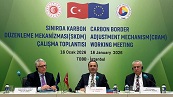
The Border Carbon Adjustment Mechanism (SKDM) Working Meeting was held at the TOBB İstanbul Service Building, hosted by the Union of Chambers and Commodity Exchanges of Türkiye (TOBB), with the participation of Deputy Minister of Trade Mustafa Tuzcu and Gerassimos Thomas, Director of the European Commission’s Directorate-General for Taxation and Customs Union (DG TAXUD).
Speaking at the opening of the meeting, TOBB Board Member Zeki Kıvanç pointed out that with the BCM entering its implementation phase as of January 1, 2026, the process has become even more critical for Türkiye. Kıvanç stated that Türkiye has been in a Customs Union with the EU for nearly 30 years and that the EU is among Türkiye’s most important trading partners, adding that the SKDM will affect many sectors in the coming period.
Kıvanç also emphasized that Türkiye adopted the Green Deal process in 2021, that legislative work is continuing in line with the 2053 net zero target, and that the Emission Trading System is planned to be implemented with the entry into force of the Climate Law.
In his speech, Kıvanç stated that when properly structured, the SKDM could serve as a transformative tool to accelerate decarbonization, emphasizing the importance of Turkish industry, and especially SMEs, adapting to the process. Kıvanç noted that while many SMEs within the EU are exempt from SKDM obligations, Turkish SMEs being subject to SKDM creates an imbalance in terms of cost and administrative burden.
Kıvanç stated that a significant transformation has been achieved in renewable energy investments in Türkiye and shared assessments that the current SKDM methodology does not take these investments into account.
TOBB Board Member Kıvanç stated that the EU’s country-based default emission values remaining high for Türkiye could negatively affect competitiveness, emphasizing that using actual emission data for Türkiye is important for both environmental accuracy and fair competition.
Speaking at the meeting, Deputy Minister of Trade Mustafa Tuzcu stated that while the SKDM is a tool designed in line with climate policy goals, it also has direct effects on industrial production and trade, adding that the process could create cost pressures in many sectors. Tuzcu emphasized that Türkiye is among the countries most affected by the SKDM, noting that the process is being closely monitored due to the scale of Türkiye-EU trade relations and Türkiye’s role in the EU supply chain.
Tuzcu noted that with the Türkiye-EU ETS Workgroup Meeting held in November, the technical process began to be addressed more systematically, pointing out the importance of this platform not being limited to information sharing but also being evaluated as a forum for consultation that will contribute to solving the problems encountered. Tuzcu also stated that dialogue and technical work would continue on topics such as default emission values under the SKDM, verification processes, and the reflection of renewable energy investments in SKDM calculations. In addition, he emphasized the need to closely monitor the process, noting that with the SKDM’s expansion into downstream products in the coming period, supply chains in sectors such as automotive, white goods, and machinery could evolve into a more complex structure. Tuzcu also stated that a follow-up meeting is planned for the end of February.
Speaking at the meeting, Gerassimos Thomas, Director-General of the European Commission’s Directorate-General for Taxation and Customs Union (DG TAXUD), referred to developments recorded since April 2024 regarding the implementation of the SKDM, stating that the mechanism was being implemented through a phased approach. Thomas noted that as of January 1, 2026, the reporting period had changed, and the quarterly reporting system had been replaced by an annual reporting system.
Thomas also stated that the gradual integration of SKDM with the Emissions Trading System (ETS) is continuing and that the aim is to make the application more manageable in line with simplification requests from industry. Thomas stated that regulations detailing the methodology and implementation principles adopted an approach that is easier to verify and more feasible, and emphasized that the main focus is on facilities providing their actual emission data, while work is being carried out to provide clarity on benchmark and default values.
In his speech, Thomas also touched upon efforts to expand the scope of the SKDM in the coming period, stating that preparations for regulations targeting downstream products, particularly in the steel and aluminum sectors, are on the agenda and that if the specified product groups are approved, they are expected to come into effect in 2028. Thomas also stated that indirect emissions and energy-related calculation elements would continue to be evaluated in the coming period.
Expressing his satisfaction with Türkiye’s steps towards establishing a carbon pricing system, Thomas emphasized that feedback from the business world on this issue would be decisive in the 2027 revision process.
The meeting concluded with presentations by Thomas and his technical team, followed by a question-and-answer session addressing questions from industry representatives regarding the SKDM process.
Your message has been sent
Thank you |
|